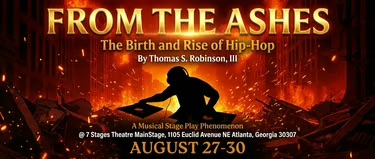
The Man Who Named the Culture
Keith "Cowboy" Wiggins


Before there was a genre, there was a word. And before the word, there was a kid from the South Bronx who just wanted to make the crowd move.
Every culture gets a name. Christianity. Jazz. Rock and Roll. The name is the container, the permission slip that tells the world: this thing is real, this thing has identity, this thing is not going anywhere. Hip-hop got its name from a man most people cannot pick out of a lineup. His government name was Robert Keith Wiggins. The block called him Cowboy.
Born September 20, 1960, and raised in the South Bronx, Cowboy came up in streets that were burning, literally and figuratively, through the late seventies. Landlords torching buildings for insurance money. City services gutted. Teenagers with no rec centers and nowhere to put what was building inside them. Out of that pressure, four elements emerged: DJing, MCing, breakdancing, and graffiti. Cowboy was somewhere in the middle of all of it, every time.
THE FIRST PICK
His closest friend on the block happened to be a Barbados-born kid named Joseph Saddler, already making a name for himself spinning records at parties under the name Grandmaster Flash. Flash had the technical gift. He could isolate a breakbeat with surgical precision, looping the dopest eight bars until the crowd lost their minds. But he needed a voice. Someone to hold the mic and hold the room.
He called Cowboy.
Flash decided his set needed more vocal flavor and asked Cowboy to rap over his sets to keep the crowd interested. Cowboy was the first MC Flash ever chose.
That is not a footnote. That is the foundation. Cowboy became the first MC recruited into what would eventually become Grandmaster Flash and the Furious Five, a group whose output helped change what people believed music could carry. He was not a featured act brought in after the hype built. He was the first brick.
And his style proved it. Cowboy built the call-and-response technique: the MC device where you throw a phrase to the crowd and they throw it back. "Somebody scream." "Ho!" That back-and-forth you feel at every rap show today, the energy that makes a crowd feel like participants instead of spectators, Cowboy drew that blueprint. He did not document it. He just did it, night after night, at block parties across the Bronx.
THE NIGHT HE NAMED IT
Here is where the story gets almost mythological, except it actually happened.
Around 1978, Cowboy was clowning with a friend who had just enlisted in the U.S. Army. In that specific, street-corner way that only certain people can pull off, he started chanting at him, mimicking the cadence of soldiers in formation: hip, hop, hip, hop, hip, hop. It was a joke. Just ribbing between friends.
He later worked that 'hip hop' rhythm into his stage performance, chanting it to the crowd as part of his set. A joke became a cadence. A cadence became a name. A name became a culture.
From the Bronx party circuit, the term spread. Lovebug Starski picked it up. DJ Hollywood used it. Afrika Bambaataa eventually applied it to the broader movement, the four elements, the whole thing. But the spark came from one night, one joke, one kid mocking his friend's march.
The genre you know, the one that has shaped fashion, language, politics, and global identity across six decades, carries the name of a moment born in play. That is the kind of thing that makes you stop and reconsider how history actually gets made. It is rarely the summit meeting. It is almost always the side conversation.
THE SOUND HE LEFT BEHIND
Cowboy's rap style was conversational and physical. Built for rooms full of real people, not for headphones and streaming queues. His scatting and crowd-work were so potent that when the Sugarhill Gang recorded "Rapper's Delight" in 1979, Wonder Mike's first verse bore a close resemblance to how Cowboy moved through a performance. The Bronx sound had leaked into the studio, and Cowboy's fingerprints were on it, even if his name was not.
The group's 1980 single "Freedom" hit the R&B charts and moved over fifty thousand records. "The Message," released in 1982, rewired what people believed rap could say about the world. These are the moments the culture uses as reference points. Cowboy was inside all of them, holding down the original formation.
His scatting style was also the model for something bigger. Wonder Mike, on the very first verse of the song most people point to as hip-hop's commercial introduction, was pulling directly from what Cowboy had already built. The culture got its commercial moment; Cowboy got no credit for it.
THE SILENCE THAT FOLLOWED
By 1983, the group fractured under industry politics and personal tension between Flash and Melle Mel. Cowboy kept working, joining Melle Mel for recordings including the anti-drug single "White Lines (Don't Don't Do It)." There is a painful irony buried in that chapter. The man on a song warning the culture about cocaine was, in those final years, losing his own battle with crack addiction.
When the original Furious Five regrouped in 1988 for a comeback album on Elektra Records, they could not find Cowboy. He was not on the album. Not in the artwork. The first MC Grandmaster Flash ever chose was absent from his own reunion.
Gang Starr honored him nine years later in 'In Memory Of...' — a tribute to the fallen architects of hip-hop. But the mainstream never stopped long enough to say his name the way it deserved to be said.
On September 8, 1989, twelve days before his twenty-ninth birthday, Robert Keith Wiggins died of a drug overdose. The culture moved on. The word he gave it stayed.
WHAT COWBOY'S STORY ACTUALLY TEACHES
This is not just history. It is a lesson in how culture works, how credit moves, and what it costs to be first.
The people who name things and start things are routinely displaced by the people who scale them. Cowboy coined the term, built the techniques, and was Flash's first call. He never got the founder's credit. Knowing this going in does not make it sting less, but it changes how you think about documentation, ownership, and legacy from day one.
He also teaches something about casual moments. Cowboy was not in a boardroom naming a genre. He was clowning around with his friend on a sidewalk. The most consequential things in culture tend to arrive without fanfare. Stay sharp even when things feel like play, because play is where identity gets formed.
And then there is the harder lesson. Genius and addiction are not opposites. They run on the same nervous system. Cowboy was gifted, original, and loved. He was also lost in something he could not outrun. The culture that came after him inherited his name and his techniques. It did not inherit his pain. That part he carried alone.
Every time someone says the words "hip-hop," they are invoking a Bronx kid with a gift for working a room, a best friend with a turntable, and a joke at a soldier's expense. That is the origin. Not a label deal. Not a marketing campaign. A friendship, a block, and a word that stuck.
Say his name like you mean it: Robert Keith Wiggins. Cowboy. The man who handed us the word and never got to see what we built with it.